LBI Newsletter
Issue No. 003
|
MARK YOUR CALENDAR!
UPCOMING
.
|
|
Sales, Auctions & Latest NEWS
~>Celebration
of Champions Sale - May 25th -
Click Here!
~>North
Iowa Miniature Horse
& Donkey Sale - May 31 -June 1 -
Click here!
~>Coast
to Coast Miniature Horse
& Donkey Sale - June 1 - June 9
Click here!
|
|
|
The Southern
Miniature Horse Confederation held a
Show Training Clinic in Monticello,
Mississippi the end of February with
clinician Mike Rosauer from Stars
Miniature Horse Farm in Spurger, Texas.
|
____________________
Safety Alert – do not feed Piles
of grass clippings!
Summer mowing – a never-ending
chore. Such a pity to waste
those soft, fragrant, tasty
piles of clippings! Why not rake
them and feed them to your
horses? It’s recycling at its
best, no? No! This should be the
last thing you encourage your
horse to eat. It has to do with
that extra step: raking. Leave
them to dry on the pasture after
mowing, and they are
generally not a problem. But
never gather them into piles to
feed them to your horse. Partly
because clippings are too
easy to over-consume, and eating
large amounts at one time can
lead spikes in insulin levels or
to excess fermentation
of sugars and starches in the
hind gut, potentially causing
colic and laminitis. Secondly,
piles of clippings can rapidly
invite mold to form (especially
prevalent in hot, humid
environments), which can lead to
colic. Finally, because there is
no air inside a dense pile,
botulism can develop, which
turns this “treat” absolutely
deadly.
____________________
Calling
all Clubs!!
To be included
Email me your club NEWS!!!
____________________
|
|
|
Spring Grazing::
Dr. Juliet Getty
Getty Equine Nutrition
Transitioning a
horse from hay to pasture must be
handled with care; this point is
non-negotiable.
For every horse, a gradual change from
hay to grass is required to allow the
digestive system to adapt, but for the
insulin-resistant horse, grazing time
and duration can make the difference
between soundness and a disabling
condition like laminitis.
This time of year can be a test of
patience for horse—and owner.
The horse may be pawing at the gate to
get to the first taste of tender spring
grass, yet the owner must pay close
attention to making the transition safe
and healthful.
The first spring sprouts are actually
lower in sugars and starch
(non-structural carbohydrates—NSC)
because they use all that energy to
promote their own rapid growth. As the
leaves form, the overall
sugar and starch content increases,
making it especially tempting.
Regardless of the growth stage,
quantities should be monitored because
horses crave fresh grass and will eat
volumes of it, making their overall NSC
consumption really high—dangerously high
for horses who are overweight,
cushingoid, or who have experienced
insulin-related laminitis.
Temperature and sunlight play a major
role in the amount of NSC accumulation.
To be safe, here are the rules:
· When the night temperature is below 40
degrees F, the grass is too high in NSC.
· Once it gets above 40 degrees F at
night, the lowest NSC level is before
the sun rises.
· The NSC level is highest in late
afternoon, after a sunny day.
There is no
exact “best time” to turn out your
horses on pasture. Generally speaking in
moderate climates, it’s safest before
dawn, until approximately 10:00 am, and
then again at night, starting at around
11:00 pm. Start slowly, offering hay
when horses are not on fresh grass.
Finally, test your pasture! Yes, testing
is not only for hay. It will take the
guesswork out of knowing which times are
best.
|
|
|
IS YOUR
HORSE'S COAT Color RUSTING?
The dark
color of your horse’s coat, mane, and
tail can change color. This is often
attributed to exposure to sunlight.
But red tips on dark manes and
dark coats, particularly noticeable in
bays and black horses, may be due to a
copper deficiency.
Fortunately, this is easy to fix. But it
requires knowing the levels of copper
and zinc in the entire diet.
Copper and zinc need to be balanced. Too
much of one can interfere with the
uptake of the other. The ideal copper to
zinc ratio is 1:3.
To bring your horse’s diet within this
level, you must evaluate everything you
are feeding, including hay, pasture,
feeds, and supplements. The most common
mineral imbalance found in hay is too
much iron combined with low zinc and
copper levels. A high iron concentration
can interfere with both zinc and copper
absorption, making already low levels of
these minerals even less available to
your horse. Strive for no more than 8
times more iron than zinc.
The “rusting” of your horse’s hair and
mane may be the tip of the iceberg. Zinc
and copper are involved in many
important bodily functions including red
blood cell health, metabolic enzymes,
immune function, and the overall health
of tendons, ligaments, hooves, and
bones. Go deeper than the surface –
protect your horse’s overall health by
assessing the mineral content of the
entire diet.
Thank you to Dr. Juliet Getty/Getty
Equine Nutrition |
|
|
CLUB NEWS
Southern Miniature Horse
Confederation.
submitted by: Anne Collum,
MS.
'The
Southern Miniature Horse
Confederation held a Show
Training Clinic in Monticello,
Mississippi the end of February with
clinician Mike Rosauer from Stars
Miniature Horse Farm in Spurger,
Texas.
The clinic was available free to
anyone with an AMHA Amateur card and
open to the public for a nominal
charge. A large crowd
attended, it was very educational
and enjoyed by all.
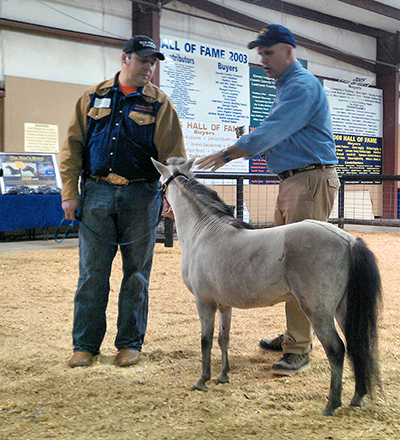
Mike
Rosauer with and Tommy Spicer of
Diamond S Miniatures with his 2012
AMHA World Top Five and 1st place
Honor Roll AOTE Senior Stallion
Glenns Diamond Gem.
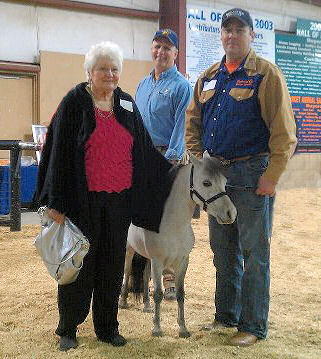
Mike, Tommy and Diamond Gem's
breeder Madge Glenn of Glenn Oaks
Miniatures, Meridian, MS.
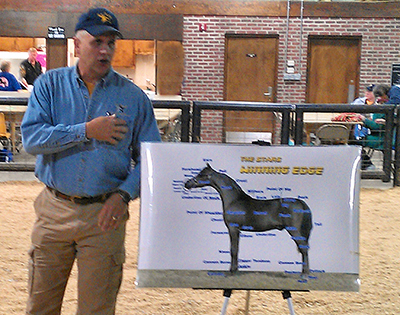
The
information Mike provided was
excellent, it included teaching the
conformation and features of a
correct miniature horse, as well as
how to condition, clip, train,
present and enjoy your miniature
horse in the ring.
A special "thank you" to Mike
Rosauer! and also to Lil Beginnings
for their participation in making
this clinic such a great success.
You can view the SMHC club Website
here
Click
here to visit the Rosauer's and
view their Stars Winning Edge
products.
Members:
If you
would like to
submit a article to be
considered for our Newsletter
about your club please
click here to email.
|
LBI's Small Horse Connect
Members Live Foal Cams
CLICK HERE |
From our Info. Files

Monitoring Your Horse's
Vital Signs
by:
Cynthia A. McCall, Extension Animal
Scientist, Associate Professor,
Animal And Dairy Science
Vital signs are
measurements of body functions that
indicate the health status of the
animal. Body temperature, heart rate
and respiration (breathing) rate are
some easily monitored and commonly
used vital signs. A horse's vital
signs usually fall within an average
range for all horses. However, there
are individual differences in vital
signs, and some healthy horses may
have a slightly higher or lower
measurement than the average.
Because of small individual
differences in values of vital
signs,
it is important to know the
usual value for your horse.
Practice
monitoring your horse's vital signs
so you and your horse are
comfortable with the procedures and
you have confidence in your results.
Not every method of measuring vital
signs is presented in this
publication. However, if you become
familiar with the simple methods
presented here, you can easily
monitor your horse's health status.
Whenever you are in doubt
about your horse's health, contact
your veterinarian for advice..
....
Read the rest
HERE!!!
|
Helpful items:
CLICK HERE FOR OUR
FOALING DATE CALCULATOR!!!
|
|
Keeping LBI FREE for all to use.
Your Gold Star membership
listing in the popular Small
Horse Connect is so important as
it keeps us going by allowing us
to give all that we offer to the
Miniature Horse & Pony
community. We don't just take
your money, we GIVE BACK through
our constant upgrades to
this interactive web site. The
LBI web site is advertised in
many printed magazines and uses
paid SEO and paid promotions in
social media for our advertisers
to gain even more visitors.
AND let's not forget,
your membership gets YOUR Web
site noticed!
Your membership listing
includes...
-
FULL Gold Star LISTING on
Small Horse Connect.
-
Text Link to your web site
on the
LB Gold Members Text Links Page.
-
Discounts on advertising.
-
AND for
new members 1 month FREE
BANNER with design.
All for $42. U.S. funds / per
year...only $3.50 a month WHAT?
|
NEW!
Maybe Baby by
Mare Stare LLC
One Drop Milk Test Strips
Introducing a line of the "One
Drop" Equine Milk Test Strips.
No
Mixing - No Fuss - Instant
Results and added peace of mind.
In use by Mare Stare Customers
for over a year.
Referrals available!!
Reduce the "guess
work" by using Maybe Baby test
strips! These strips have been
tested extensively by Mare Stare
customers and have been deemed
exceedingly reliable for predicting
when your mare will foal. Super easy
to use and read.
VISIT:
MaybeBabyByMareStare.com
|
Members Premium Horse
Classifieds
A new twist on the sale
board!!
I know this was promised last
year to be up by Jan. but it
is coming I promise!
(
along with many NEW changes to
LBI!
)
Classified ads
designed by us
including adding your
provided pedigree, videos
and show results.
These ads will run on a page in
ascending order for 60 days. The
page will be featured throughout
LBI with attention grabbers
including a Large rotating
banner, text links in the
upcoming NEWS section of the
sale board and forums as well as
a link included in our
Newsletter.
Ads will be subject to
approval, horses must be
presented at their best
and submitted with very
large, clear professional
"looking" photos.
-
|
VIEW
CURRENT ISSUES OF THE FOLLOWING
PRINT MAGAZINES HERE


|
|
|
|
|
|
|