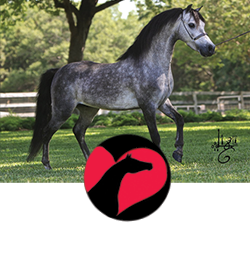
PHOTO ABOVE COURTESY OF ERL MINIATURE HORSES - TEXAS & LIZ MCMILLAN
Vaccination is a term with which every horse owner is familiar. Moreover, many do not realize the importance of a well-planned vaccination program for horses. A vaccination program, designed by a veterinarian, will help ensure the horses in a stable stay healthy and productive. An effective and successful vaccination program against infectious diseases is an essential component and key management tool for any horse operation wishing to institute a preventative medicine program. Horses, just like people, are constantly exposed to bacterial and viral organisms. Many of these can cause mild to debilitating diseases. This risk is especially significant when horses are shipped to tracks, farms, or other stables. The more a horse is away from his home environment and mingled with other horses, the greater the chance of exposure to potential carriers of infectious diseases. This is particularly true of respiratory diseases. Infectious disease control programs, in conjunction with vaccination, are important in maximizing the health, productivity, and performance of a horse. A veterinarian can help design a health program to reduce exposure to infectious disease agents in a horse’s environment to lessen the incidence of illness. Disease control programs should be tailored to individual needs, with consideration given to ages, types, activities, and number of horses in the program. The schedule below is a suggested vaccination schedule provided by the American Association of Equine Practitioners, and is based on generally accepted veterinary practices.
From the AAEP - the American Association
of Equine Practitioners
Core Vaccination Guidelines
Includes: Rabies, Eastern/Western Encephalomyelitis , Tetanus and West Nile.
Risk Based
Vaccination Guidelines
Includes: Anthrax, Botulism, Equine Herpesvirus (Rhinopneumonitis), Equine Viral
Arteritis, Equine Influenza, Potomac Horse Fever, Rotaviral Diarrhea, Snake
Bite, Strangles.
Foal
Vaccinations pdf
Adult Equine
Vaccinations pdf
It is important to vaccinate broodmares 4 to 6 weeks before foaling for their
own protection, as well as to maximize concentrations of immunoglobulin in their
colostrum to be passively transferred to their foals.
I inoculate my Mares with EWT 30 to 45 days prior to anticipation of foaling,
however You should speak to your veterinarian to make sure this is right for
you.
Recognize that simply vaccinating the mare is not sufficient for protection of
the foal; successful passive transfer must also occur. The foal must receive
adequate amounts of high quality colostrum and absorb adequate amounts of
specific colostral immunoglobulins before absorption of macromolecules ceases
(generally within 12- 24 hours). Specific colostral immunoglobulins provide
protection against field infections for several months but also may interfere
with vaccinal antigens and may interfere with foal responses to vaccines; a
phenomenon termed “maternal antibody interference.”
Although protective concentrations of maternal antibody decline with time,
vaccination of a foal while these colostral antibodies are present - even at
concentrations less than those considered to be protective - is often of minimal
value because of maternal antibody interference. Consequently, a foal may be
susceptible to infection before the primary vaccinal series is completed.
Management directed at minimizing exposure to infectious agents is key during
this interval.
Foals with residual maternal antibodies generally produce a greater serologic
response to killed vaccines when an initial series of three doses is
administered rather than the 2-dose series recommended by most manufacturers of
vaccines for older horses without residual maternal antibodies.
Please pay special attention to the safety indications regarding vaccinations
for pregnant mares.
Also READ the fine print and do Not assume that if it is safe for a big horses
it is safe for a horse 1/4 in size.
Do NOT give Miniature Horses the "Combo" shots (shots that include West Nile)
it is too much for their systems, some companies in the fine print warn against
it's use on ponies. PLEASE Always read the fine print. DO NOT give West Nile to
Miniatures in their first trimester of pregnancy. Make sure your breeding
stallions are inoculated 3 months prior to season.
On Miniature Horses if you need to give, as an example, EE/T and WN (Double or
Triple Encephalomylitis, Tetanus and West Nile) Give your EE/T in one side of
the neck or buttocks one week, then give the West Nile separately A WEEK LATER
in the other side. OR if you use EE/F/T Give it in 2 shots, EE/F then a couple
days later give the T.
AGAIN -Discuss this with your Vet.
WORMING
The following are some wonderful links on this subject:
http://iamranch.com/miniwormer.htm
http://cruzminihorses.com/worming.html
http://www.americanminiaturehorse.com/worming.htm
All three links are recommendations from different parts of the country. ALWAYS
talk this over with your own Vet.
~ PLEASE NOTE ~
KNOW your Miniature Horses weight!
Totally serious, you need to know how much your mini weighs!
My de-worming program has worked well for me. I use 3
different parasitic wormers throughout the year, in the fall/winter I use
Ivermectin for Bots. I add a wormer that also eradicates tape worm in the
spring. I use a mild dewormer every 30 days up to 6 months of age for foals.
Since late 2008 I base giving my horses medicine to kill parasites on a "if
needed" basis by having a fecal egg count done then "IF needed" mine receive a
dose in the Spring and Fall only.
Worming is done by the weight of the horse so pick up a pony/mini weight tape,
measure around the mini just behind the front legs and it will give you an idea
of the weight of your animal.
♥Be sure not to overdose. And make sure the ring on the wormer does not slip.
Don't panic if you do, most such as Ivermectin and Fenbendazole are safe enough
that you can double or triple with no side effects but BE EXTREMELY CAREFUL with
others. NEVER use Moxidectrin (one brand name is Quest) on a Miniature Horse,
there is NO room for error -UNLESS you know for a fact the horses weight
and also the horses history in that you are positive it does not have a high
worm load.
1. Conduct fecal egg count tests for all horses on your property. You can
purchase test kits on-line. All you do is put some of your horse's manure in a
small vial, fill out the form, include a check (usually under $20), and mail it
off. You'll receive your results in the mail in a week or so. Or you can have
your veterinarian do the test for you.
2. Immediately de-worm horses with positive test results (more than 100 eggs).
3. For horses with negative test results (100 eggs or less), deworm ONLY TWICE a
year as above. with a dewormer that contains praziquantel and ivermectin (e.g.,
Zimecterin Gold or Equimax) The first deworming should be during mid-fly season
and the second during the winter freeze.
The reason you must still deworm with praziquantel is that
bots and tapeworms don’t show up on fecal egg counts.
Praziquantel is especially effective against these kinds of parasites. With
miniatures be very careful.
If a horse is carrying a very heavy parasite load, it is best to de-worm
gradually! a large die-off of parasites can make a horse very ill..to the point
of colic and death. If your horse has a very high fecal egg count, consult your
veterinarian before de-worming.
Here is some good information from the AAEP about:
There are a lot of dewormers out there that you can use on pregnant mares but
before you purchase a wormer for your mare, just check over the label quick and
see if it's safe for pregnant and/or lactating mares. NEVER use Moxidectrin,
one brand name is "Quest" on a Miniature Horse, there is NO room for error -UNLESS
you know for a fact the horses weight and the horses history in that you are
positive it does not have a high worm load.
After the foal is up, dry and has had it's colostrum I then give the mare a warm
mash, I also give her a little Banamine for pain. Shortly there after she will
be wormed.
I myself NEVER deworm a mare in the last trimester of pregnancy. I worm with
tube Ivermectin on the day her foal is born, immediately after her first stool.
This will passively transfer to the foal.
Shots (reactions)
There is so much nice deep muscle in the rump, that is the ideal spot on a mini.
It can be dangerous on a big one, but I used to give the shots in the butt of
the big ones too. I sure wouldn't want a shot in the neck! I try to give two
shots at a time. And I ALWAYS watch for reactions. I give the shots on a day
when I will be home, give it early in the day so I can watch and if I have to
call the vet it isn't overtime!
I always have a drawn up and ready dose of epi. with me when I'm giving
inoculations.
I've given my own vaccines since we've had horses, & the only problem was a
swollen spot on the neck and the mare did not want to lower her head, it was
obvious for days she was stiff, my vet said it was caused by failing to get the
injection firmly in muscle where it could be absorbed. with the smaller muscle
mass on the minis, he recommends the butt site. Most years I've bought the
vaccines from Jeffers, the EWT & the Rhino-flu in separate injections. We have a
law in Ga. mandating that all horses in the state must have a coggins test for
EIA at least once a year, the vet comes out to do those and rabies.
Rhino shots are known to produce swelling and soreness sometimes especially when
given in the neck. Any vaccine marked Intramuscular Injection is best given in
the large muscles of the rear end along the back of the leg. Do not give them in
the top of the hip/croup, or the "side" of the hip as the sciatic nerve runs
between the gluteal muscles in that area. Your vet can show you the safe places
to give injections, and you will save a lot of money!
-- If you stay in horses very long there will probably come a time a horse needs
shots daily and then you can do it without having the vet out daily! --- If the
amount of a med to be given is more than 2cc I also divide the dose so there
isn't such a large amount that must be absorbed from one site. ALWAYS wet the
intended injection site with alcohol to avoid introducing bacteria into the site
as the needle penetrates the skin, this one simple, and often not done, act can
prevent many abscesses and infections!
--- I order my vaccines through
Jeffers
Equine Supply and have always been satisfied with the service and prices.
You can request a catalog at 1-800-533-3377--- Cost is a bit cheaper than buying
the vaccines separate like I used to. I get it by the 10 dose vials which, saves
a little more.
Note: The information on inoculations was provided by the American Association
of Equine Practitioners and should be used as a basis in discussing specific
needs with a veterinarian. His or her recommendations will be based on a variety
of factors, including age, sex, type of horse, and geographic location. He or
she will have insight into the diseases endemic to a region and the likelihood
of disease outbreaks at specific times of year. Please pay special attention to
the safety indications regarding vaccinations for pregnant mares.
Do you
have a topic you would like to see here or article you'd like to submit?
Please
E-mail me
We wish to thank all of the people that have shared their experiences &
knowledge with others by sending us tips and donating articles. For articles on
our pages that have been reproduced, credit is given and a link is posted to
your site (reproducing articles archives information on our server which
decreases broken links that occur when content on the site was either removed or
relocated without proper redirects in place to lead visitors to the correct
page.)
Please forgive us if we did not give full credit for any one of the wonderful
articles here. If we have used something of yours that you would like removed
please let me know.
All rights reserved. No part of any pages may be reproduced in any form or
means without written permission of Lil Beginnings Miniature Horses.
Lil Beginnings Miniature Horses is not responsible for any death, injuries,
loss, or other damages which may result from the use of the information in our
pages.
<<< Back to our articles index
Vaccination schedules, Worming protocol, mini horse
inoculations,